My gym instructor mentioned last month that she’s tracking client progress through three different apps now, one for workout plans, one for nutrition, one her gym forces everyone onto for class bookings. None of them talk to each other. She’s manually copying numbers between them most evenings after her last session of the day.
That’s not a small annoyance, that’s a genuinely broken workflow, and it’s exactly the kind of problem decent fitness app development services are supposed to solve before a product ever reaches someone like her. The fitness app space is enormous right now, but plenty of products in it are solving the wrong problem, or solving the right problem badly. Here’s what actually goes into building one that holds up, what features genuinely matter, and what the real development process looks like once you get past the pitch deck.
What Actually Makes a Fitness App Worth Using
Personalized Workout and Nutrition Plans
Generic plans get abandoned fast. A 45-year-old recovering from a knee injury and a 23-year-old training for a marathon need completely different programming, and an app that treats them identically loses both within a few weeks.
The apps that retain users build plans around someone’s actual history, goals, and physical constraints, and adjust over time as that person’s data comes in. This isn’t a nice-to-have anymore. It’s close to the baseline expectation users walk in with now.
Wearable Integration That Actually Works
If your app can’t pull data cleanly from an Apple Watch, a Fitbit, or a Garmin, it feels incomplete the moment someone opens it next to their existing device. Heart rate during a workout, sleep quality the night before, recovery scores, this data needs to flow into the app automatically rather than requiring manual entry, because manual entry is exactly the kind of friction that gets abandoned within a week.
Progress Tracking That’s Actually Motivating, Not Just Numbers
Raw data dumps don’t motivate anyone. Visual progress charts, milestone celebrations, before-and-after comparisons, these turn abstract numbers into something that actually feels like progress a person can see and feel good about.
Social and Community Features
Solo fitness journeys have a much higher drop-off rate than ones with any social component built in. Leaderboards, shared challenges, the ability to see a friend’s activity and feel a nudge of friendly competition, these features tap into something that pure individual tracking never quite manages on its own.
Gamification That Doesn’t Feel Gimmicky
Streaks, badges, level-ups, done thoughtfully these create genuine habit loops. Done carelessly they feel like a cheap layer slapped on top of an otherwise solid product. The difference comes down to whether the gamification connects to something the user actually cares about, or whether it’s just points for the sake of points.
Live or On-Demand Coaching
Whether it’s a real human trainer on a video call or an AI-driven form correction feature watching through a phone camera, some layer of coaching presence makes a workout app feel like guidance rather than just a glorified timer with exercise names attached.
The Real Benefits, Beyond the Obvious
For Users
A well-built fitness app genuinely changes behavior in a way a paper plan or a generic YouTube video never quite manages, because it adapts, remembers context, and nudges at the right moments rather than requiring someone to remember everything themselves.
For Gyms and Trainers
A custom app extends a trainer’s reach well past their actual working hours. A client doing a home workout on a Sunday can still follow a program built specifically for them, log results that the trainer reviews Monday morning, and stay accountable without needing constant direct supervision.
For Healthcare and Wellness Providers
Fitness apps increasingly bridge into preventative health, tracking metrics that matter for chronic condition management, feeding relevant data to care teams, and turning general fitness tracking into something with genuine clinical relevance for the right use cases.
For the Business Building It
A fitness app with strong retention becomes a recurring revenue engine through subscriptions, rather than a one-time download that gets deleted within a month. The apps making real money in this space aren’t winning on flashy features, they’re winning on whether people are still opening the app three months later.
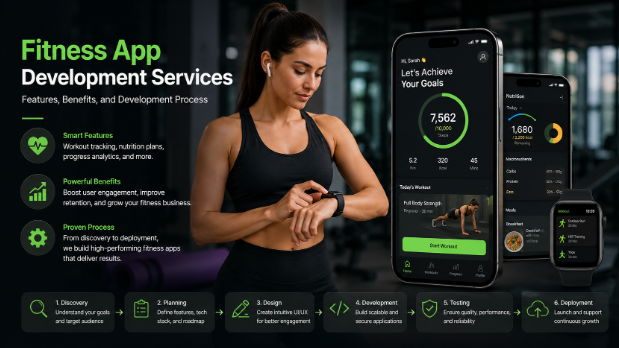
What the Actual Development Process Looks Like
Discovery and Strategy — 2 to 4 Weeks
Before any design work starts, this phase nails down exactly who the app is for, what specific problem it solves, which platform makes sense, and what success actually looks like six months post-launch. Skipping this is the single most common reason fitness apps end up unfocused, trying to be everything for everyone and ending up genuinely useful for nobody.
UX and UI Design — 3 to 5 Weeks
Fitness app design carries a unique challenge most other categories don’t deal with as much, people are often using these monitoring apps mid-workout, sweaty, glancing at a screen for a second between sets. Interfaces need to be readable at a glance, navigable without much precision, and built around quick interactions rather than long, careful reading.
Core Development — 8 to 16 Weeks
This is where wearable integrations, backend infrastructure, the actual workout and nutrition logic, and any AI-driven personalization all get built out. Timeline here depends heavily on how many integrations are involved and how sophisticated the personalization engine needs to be. A simple workout tracker moves faster than a platform pulling in continuous biometric data and adjusting plans in real time.
Testing Across Real Devices and Real Users — 3 to 5 Weeks
Fitness apps get used in genuinely unpredictable conditions, gyms with patchy wifi, outdoor runs with spotty cell signal, sweaty fingers missing taps on a screen. Testing needs to reflect that reality rather than just clean conditions on a developer’s desk. Real user testing during a real workout surfaces problems no amount of office-based QA ever catches.
Launch and Ongoing Iteration
Launch isn’t the end. Retention data starts coming in immediately, and the apps that succeed long-term keep iterating based on what that data actually shows, rather than treating the initial launch version as the finished product.
What This Actually Costs
Fitness app development cost varies enormously depending on feature complexity, platform choice, and how much custom personalization or wearable integration is involved. A relatively simple workout tracker with basic logging can run somewhere in the tens of thousands of dollars. A full platform with AI-driven personalization, deep wearable integration, social features, and live coaching capability climbs considerably higher, often into six figures once everything’s accounted for, including the ongoing maintenance that follows launch.
The number that actually matters more than the build cost itself is the cost of getting it wrong, building something nobody retains past month one, and having to rebuild core pieces later once real usage data reveals what should have been planned for from the start.
The Honest Takeaway
Building a fitness app that actually works isn’t about cramming in every trendy feature competitors have. It’s about understanding specifically who you’re building for, integrating cleanly with the devices people already use, designing for genuine motivation rather than gimmicks, and treating the development process as a sequence of deliberate decisions rather than a race to ship something that looks good in a demo.
The apps that last are the ones still open on someone’s phone six months after they downloaded it, not the ones that looked impressive in a launch announcement and quietly disappeared from everyone’s home screen a few weeks later.
About the Author