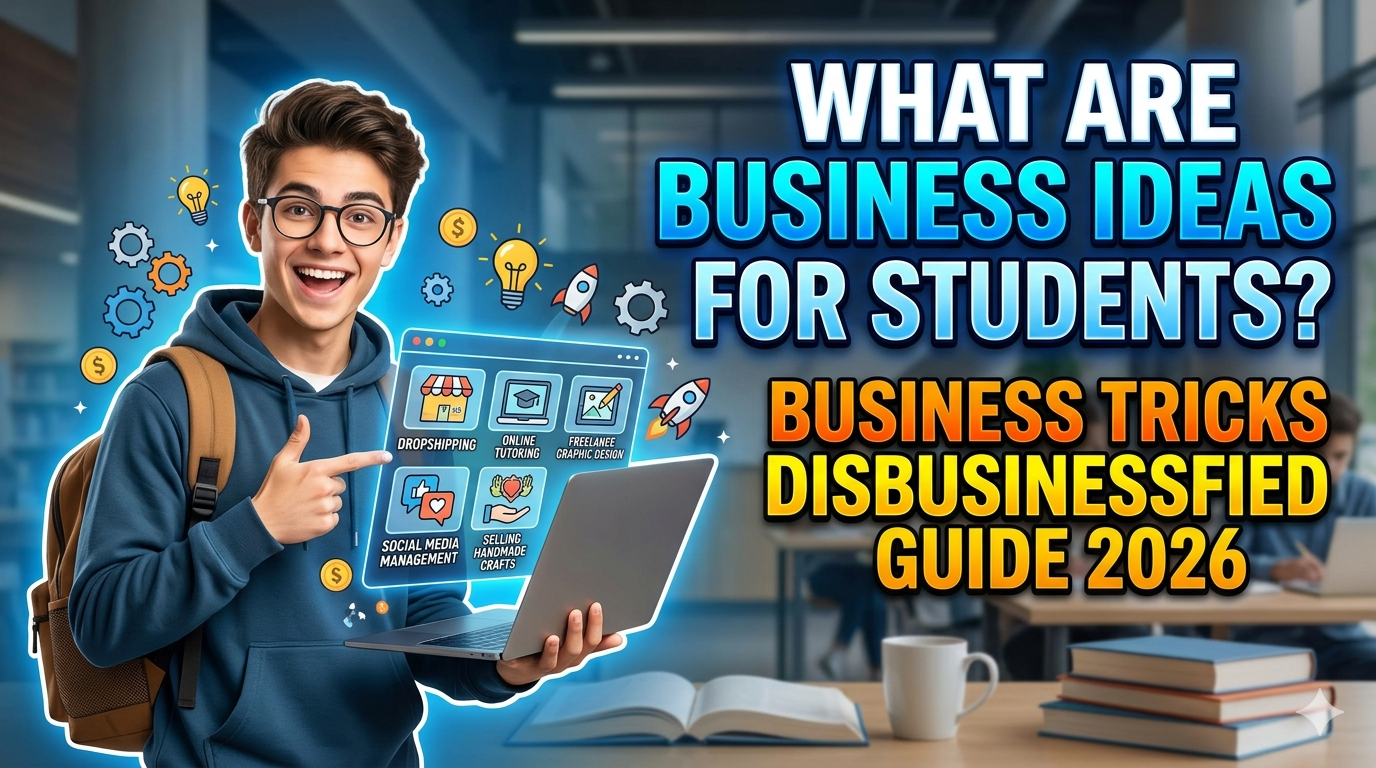
what are business ideas for students disbusinessfied
If you’re searching for what are business ideas for students disbusinessfied, you’re likely not just looking for random ideas, you want something practical, realistic, and actually capable of making money while you study.
This guide breaks everything down in a simple way: student-friendly business ideas, smart business tricks disbusinessfied, and a clear system for how to find a good business to start disbusinessfied without wasting time or money.
Unlike generic lists, this article focuses on how student businesses actually work in real life, how to choose the right one, and how to turn a small idea into real income.
Why Students Should Start a Business in 2026
Starting a business as a student is no longer something “extra”—it is becoming a major advantage.
Today, students have access to:
- Free learning resources
- Social media platforms for marketing
- AI tools for productivity
- Global freelance marketplaces
- Low-cost startup tools
This means a student can start a business with almost zero investment.
But the real advantage is not money, it is experience + skill building + independence.
Students who start early often:
- Build income before graduation
- Gain real-world skills
- Develop confidence
- Build portfolios for jobs or freelancing
- Learn how money actually works
So when people ask what are business ideas for students disbusinessfied, the real answer is:
Businesses that help you earn, learn, and grow at the same time.
What Are Business Ideas for Students Disbusinessfied?
Let’s break this into practical, realistic categories.
1. Freelancing (Fastest Skill-to-Cash Model)
Freelancing is one of the strongest student business models.
You can sell:
- Writing
- Graphic design
- Video editing
- Social media posts
- Presentation design
Why it works:
- No investment needed
- Immediate demand on platforms like Fiverr and Upwork
- Flexible timing
Example:
A student good at writing can start by creating blog posts for small businesses. After building experience, they can move to higher-paying niches like tech or finance writing.
2. Tutoring (High Trust Business)
Tutoring is one of the oldest but still most effective student businesses.
You can teach:
- School subjects
- Languages
- Exam preparation
- Skills like coding or math
Why it works:
- You already know the material
- Parents actively pay for tutoring
- Online tutoring expands your reach
Scaling idea:
Start 1-on-1 tutoring → move to group classes → create digital study guides.
3. Content Creation (Long-Term Digital Asset)
Content creation includes:
- YouTube videos
- TikTok content
- Instagram reels
- Blogging
Why it works:
- Builds audience over time
- Can be monetized in multiple ways
- No physical product needed
Monetization:
- Ads
- Sponsorships
- Affiliate marketing
- Product sales
This is one of the most powerful answers to what are business ideas for students disbusinessfied because it builds long-term income.
4. Selling Digital Products
Digital products include:
- Study notes
- Templates
- Guides
- E-books
- Revision materials
Why it works:
- Create once, sell unlimited times
- No inventory
- High profit margins
Example:
A student creates “exam revision notes” and sells them on platforms like Etsy or Gumroad.
5. Social Media Management
Businesses need online presence—but many don’t know how to manage it.
Students can offer:
- Instagram page management
- Content creation
- Post scheduling
- Engagement strategies
Why it works:
- High demand from small businesses
- Simple skills needed
- Monthly recurring income possible
6. Reselling Business
Reselling includes:
- Thrift clothes
- Used electronics
- Books
- Sneakers
Why it works:
- Low entry cost
- Easy to start locally
- Fast profit cycles
Students often use platforms like:
- Facebook Marketplace
- eBay
- Vinted
Business Tricks Disbusinessfied
Now let’s go deeper than ideas.
Most students fail not because of bad ideas, but because they don’t use smart business tricks.
Here are the real strategies behind success:
1. Start With Skills, Not Ideas
Most beginners do this wrong.
They think:
“What business should I start?”
Instead, think:
“What can I already do that someone will pay for?”
Skills always come first.
Examples:
- Good at writing → freelancing
- Good at explaining → tutoring
- Good at editing → content creation
2. Solve a Small Problem First
Big businesses start small.
Instead of thinking:
- “I want to build a big brand”
Think:
- “What small problem can I solve today?”
Examples:
- Students need notes → sell study guides
- Businesses need posts → social media services
- People are busy → cleaning service
3. Validate Before You Build
Never spend weeks building something no one wants.
Instead:
- Ask people
- Post offers online
- Test demand quickly
If nobody responds → change idea immediately.
4. Focus on One Platform First
Don’t try:
- YouTube + TikTok + Instagram + Blog all together
Pick ONE:
- Master it
- Grow it
- Then expand
5. Reinvest Early Profits
Instead of spending money immediately:
- Upgrade tools
- Improve branding
- Advertise services
- Learn new skills
This is how small businesses grow fast.
6. Build Assets, Not Just Income
There are two types of business:
Income-Based:
- Tutoring
- Freelancing
- Cleaning
Asset-Based:
- YouTube channel
- Blog
- Online course
- Digital products
Assets keep earning even when you stop working.
How to Find a Good Business to Start Disbusinessfied
This is the most important section.
Most students fail because they choose random ideas instead of structured ones.
Use this system:
Step 1: Identify Your Strengths
Ask:
- What am I naturally good at?
- What do people ask me for help with?
- What do I enjoy doing?
Write 3 skills.
Step 2: Check Market Demand
Ask:
- Is anyone already paying for this?
- Are businesses or students already buying it?
If yes → good sign.
Step 3: Look for Problems
Good businesses solve problems like:
- Lack of time
- Lack of knowledge
- Lack of skill
- Convenience needs
No problem = no business.
Step 4: Start Small (MVP Method)
Don’t build a full business.
Start with:
- One service
- One product
- One platform
Example:
Instead of building a tutoring company → start tutoring 1 student.
Step 5: Improve Based on Feedback
After first customers:
- Ask what they liked
- Ask what they didn’t
- Improve fast
Common Mistakes Student Entrepreneurs Make
Avoid these:
1. Trying too many ideas at once
Focus = success.
2. Waiting for perfection
Start messy, improve later.
3. Copying others blindly
Adapt ideas to your skills.
4. Ignoring marketing
Even good ideas fail without visibility.
5. Giving up too early
Most businesses take time to grow.
Best Student Business Ideas Summary
Here is a quick summary of the strongest ideas:
Fast Income:
- Freelancing
- Tutoring
- Cleaning services
- Reselling
- Social media management
Long-Term Growth:
- Content creation
- Blogging
- YouTube channel
- Affiliate marketing
- Online courses
Skill + Income Combo:
- Graphic design
- Video editing
- Digital products
- App development
Final Thoughts
When people search what are business ideas for students disbusinessfied, they are usually looking for clarity—not confusion.
The truth is simple:
- You don’t need the perfect idea
- You need a working idea
- You need consistency
- You need action
The smartest students don’t wait for opportunities—they create them using small, simple steps.
If you understand the business tricks disbusinessfied and apply the system for how to find a good business to start disbusinessfied, you already have everything needed to start.
About the Author